Care
Notice vulnerability and support life. Ripley's bond with Newt and Uraraka's protection of an exhausted Deku make this visible.
How care, empathy, love and connection become a character's power.
A study of specific scenes: what helps a heroine act, and what changes because of it.
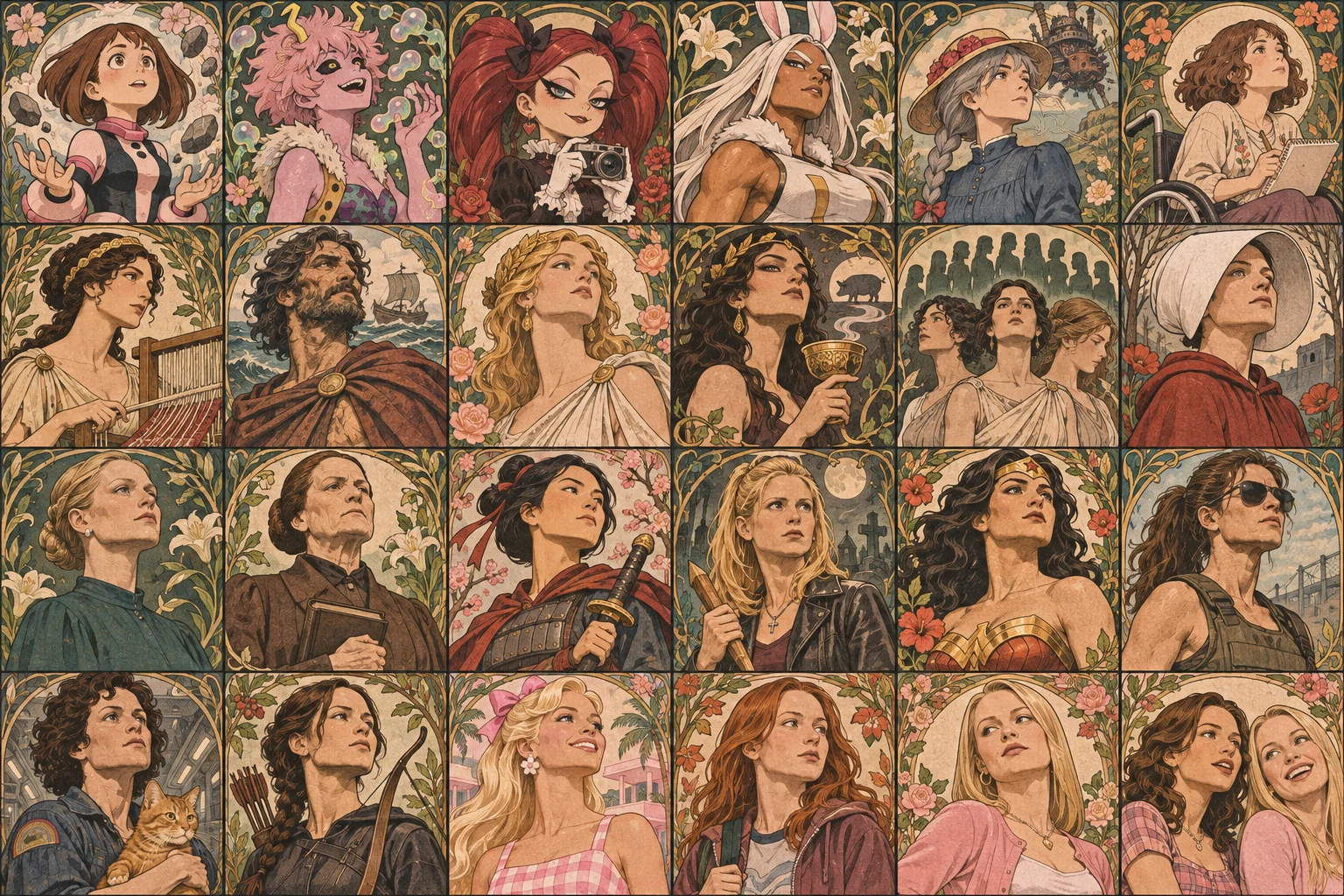
I am interested in feminine heroism. Care, love, empathy, receptivity and connection help a character face a real trial. I want to see how those qualities work inside the story.
A woman with a weapon can be a wonderful character. Her sex alone does not answer my question. What makes her heroism feminine?
For each story, I look for a quality, an action and a consequence. Being stronger than an opponent is not enough evidence. Hearing pain, protecting life or helping someone grow gives us something more specific to examine.
What changes because the heroine cares, loves or understands? That is the question behind this collection.
Sophie creates a home and restores connection. La Brava literally strengthens the person she loves. Ripley protects a child. Uraraka sees that a rescuer may need rescuing. Vasilisa sustains a bond with her mother's gift and learns discernment.
The starting point was a Based Camp conversation with Simone and Malcolm Collins. They criticize Maureen Murdock's heroine's journey and praise several anime characters. I wanted to look beyond the argument and study what the characters actually do.
Notice vulnerability and support life. Ripley's bond with Newt and Uraraka's protection of an exhausted Deku make this visible.
Hear another person's pain before trying to correct them. Enki's emissaries do this in the Inanna myth.
Give someone else a greater ability to act. La Brava's Quirk turns that image into a rule of her world.
Accept guidance, notice another person's state, and trust inner support. Vasilisa sustains her relationship with the doll.
Build a home, relationships, and a shared world. Sophie gathers people together. Penelope protects a household through craft and memory.
Remain able to cry, love and mourn. Katniss's farewell restores Rue's dignity.
Act through trust, cooperation and mutual help. This power may be shared across several people.
The result matters more than the costume. Beauty, a dress or falling in love proves little on its own. Patience without a choice is not automatically heroic.
Love and care can also lead to forceful action. Ripley fights for Newt. I distinguish the relationship that moves her from the means she uses.
Regina and Serena test the boundaries. Relationships can become instruments of control. A wish for a family can coexist with cruelty. The concern for another person is what disappears in those cases.
The American scholar of mythology described departure, initiation and return in The Hero with a Thousand Faces, published in 1949. Many examples are male, but women can also follow that pattern.
Read the foundation's explanationThe Russian folklorist identified 31 narrative functions in Morphology of the Folktale, published in 1928. Helpers, donors and tests offer another way to examine Vasilisa's story.
Explore Propp's frameworkThe American psychotherapist published The Heroine's Journey in 1990. It follows a search for wholeness after success by someone else's rules, including a return to rejected parts of the self.
Read Murdock's accountThe podcast discusses Campbell and Murdock. Propp is an additional tool here. Campbell was a scholar of mythology; the hosts' description of him as a Jungian psychologist is inaccurate.
According to Murdock's recollection, Campbell told her that a woman was already the place the hero sought to reach. That answer does not satisfy me. A woman needs her own journey, trials and room to change.
A separate framework can still become too narrow. I do not want to assume that every heroine must resolve the same conflict with her mother. Specific stories matter more than forcing everyone into a pattern.
These are summaries, not mandatory steps. The first two describe the authors' models. The third is my comparison method. Sex alone does not assign a character to one model.
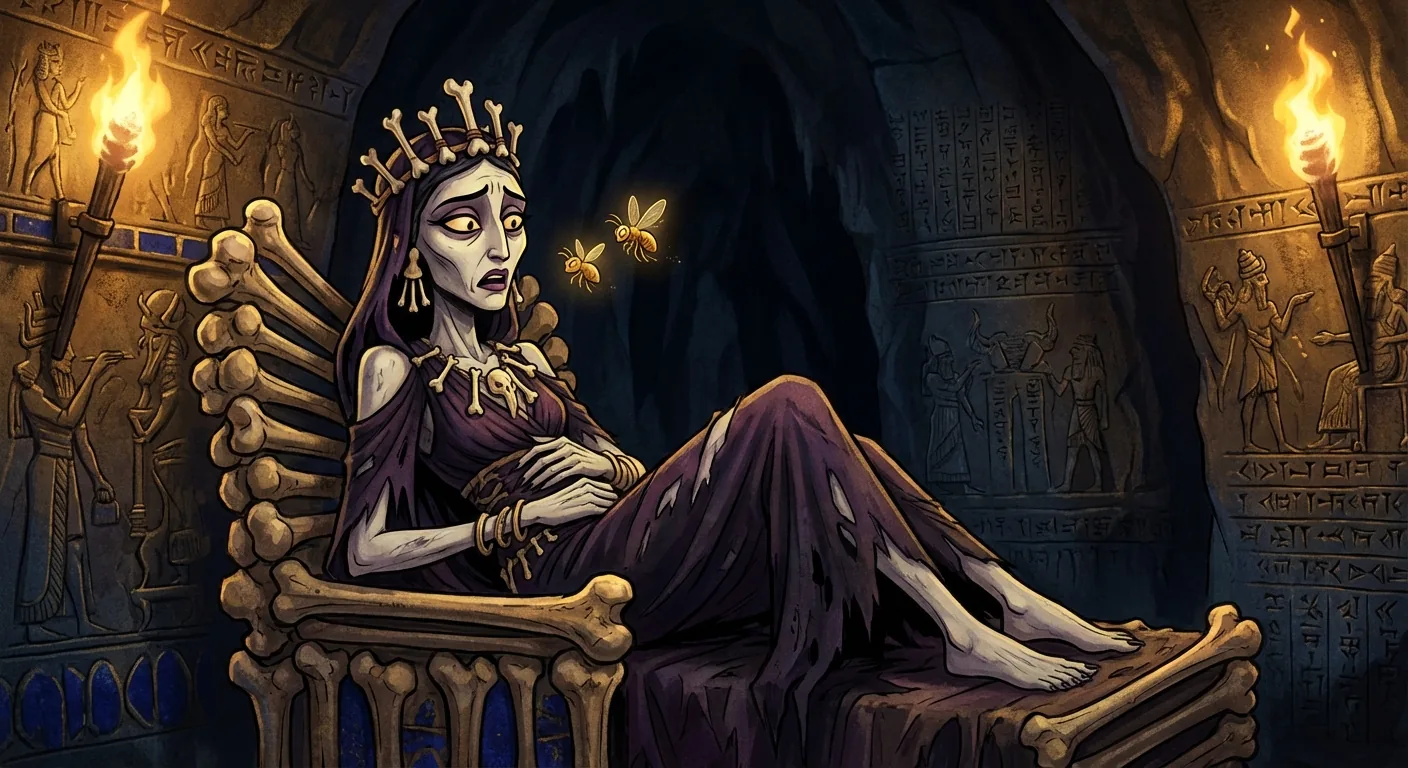
Scene. Ninshubur mourns Inanna and seeks help. Enki's emissaries respond to Ereshkigal's suffering. Later, Inanna herself weeps for Dumuzi.
What changes. Connection and responsiveness make return possible where divine authority alone failed.
The helpers perform the empathetic rescue. We cannot credit every action to Inanna or hide the cost transferred to Dumuzi.
Check the scene / source ↗At seven gates, Inanna loses the signs of her power. She dies below. Ninshubur seeks help; Enki's emissaries recover her body and revive her.
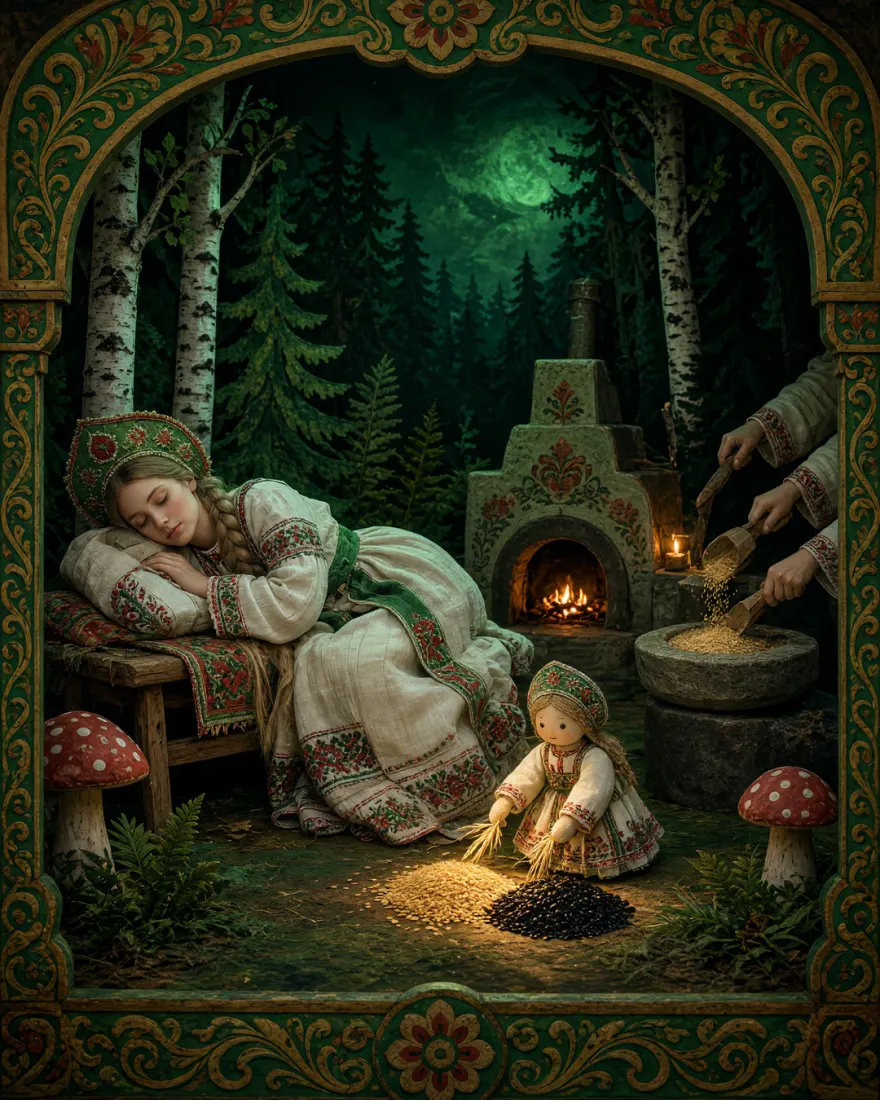
Scene. Vasilisa feeds her doll, accepts its advice, and passes Yaga's tasks. Later, she makes exceptionally fine cloth.
What changes. A sustained relationship with her helper and her craft create a path toward a life of her own.
The doll as intuition is a psychological interpretation. In the tale, it is a magical helper. Obedience to threats is not presented as a virtue.
Check the scene / source ↗Her stepmother sends her to Baba Yaga for fire. Yaga demands housework and sorting grain. The doll, a gift from her mother, helps her complete the work.
These two stories extend the podcast's examples. The illustrations come from existing illustrated stories on this site.
All 26 selected figures are examined through the same question. Core examples show a working mechanism. Mixed examples combine it with combat or other modes. Contrasts and shadow cases define its limits.
| Character | Feminine quality | Scene and consequence | Reading |
|---|---|---|---|
| Inanna | Openness to loss; accepting help; compassion across relationships | Ninshubur mourns Inanna and seeks help. Enki's emissaries respond to Ereshkigal's suffering. Later, Inanna herself weeps for Dumuzi. Connection and responsiveness make return possible where divine authority alone failed. | Distributed heroism |
| Vasilisa the Beautiful | Trust in inner support; the maternal bond; discernment; craft | Vasilisa feeds her doll, accepts its advice, and passes Yaga's tasks. Later, she makes exceptionally fine cloth. A sustained relationship with her helper and her craft create a path toward a life of her own. | Core example |
| Ochaco Uraraka | Empathy; care for the person who protects everyone else | In episode 137, Uraraka asks frightened civilians to see how wounded and exhausted Deku is. In episode 158, she keeps trying to reach Toga. The dangerous bearer of power becomes visible as a vulnerable person. The rescuer is allowed to need protection. | Core example |
| Mina Ashido / Pinky | Emotional openness; protection of friends | Mina intervenes when a frightening stranger confronts her friends. Once he leaves, she cries. Her bond with her friends gives her a reason to act through fear. Her sensitivity survives the brave act. | Mixed example |
| La Brava / Manami Aiba | Love; support; making another person stronger | La Brava tells Gentle that she loves him. Her Quirk increases his power. Later, she uses her technical skills to help the heroes. A relationship literally creates a new ability to act. | Core example |
| Mirko / Rumi Usagiyama | The chosen scene does not establish a feminine mechanism | Mirko enters close combat, suffers a serious injury, and keeps attacking. The outcome depends mainly on strength, speed, and fighting resolve. | Contrast |
| Sophie Hatter | Care; acceptance; making a home; restoring connection | Sophie brings the castle's residents together, cares for the weakened Witch of the Waste, and helps return Howl's heart. Scattered people become able to live together. Care reaches even a former enemy and supports restoration. | Core example |
| Possibly Josee / Kumiko | Receptivity; creativity; mutual support | Josee draws and gradually builds a relationship with Tsuneo. Imagination becomes a way to express herself. She gains a voice and a future within a relationship where support can become mutual. | Unconfirmed reference |
| Penelope | Fidelity; preserving a home; weaving; discernment | Penelope weaves and unweaves a shroud to delay remarriage. She tests the returning Odysseus through the secret of their marriage bed. She protects a relationship and a household through craft, memory, and careful judgment. | Core example |
| Odysseus | Returning to loved ones; a male comparison | Odysseus returns to Ithaca and reconnects with Penelope. Attachment to home gives the adventure its purpose. His actions still rely heavily on cunning, survival, and combat. | Contrast |
| Helen of Troy | Beauty and desirability without sufficient heroic action | Helen's image exists between other people's desire, war, and Penelope's hostile perspective. She reveals how femininity becomes an object of other people's power and stories. | Insufficient evidence |
| Circe | Hospitality; knowledge; guiding a traveler | After their dangerous encounter, Circe restores the men's human form and gives Odysseus instructions for the next stage. The ruler of an unfamiliar place becomes a source of help and knowledge. | Mixed example |
| The Twelve Maids | A shared voice; remembrance; witnessing together | The maids speak as a chorus and challenge the story of a restored household. Collective speech makes visible the people whose deaths sit at the edge of someone else's victory. | Mixed example |
| Offred | Memory of loved ones; inner receptivity; preserving personhood | Offred remembers and tells of a life the regime tries to reduce to a reproductive function. Her inner speech preserves human connection and a personal history. | Mixed example |
| Serena Joy | Distorted family care and desire for motherhood | Serena seeks a child through unequal power over a Handmaid. A family goal becomes a justification for control over another person's body. | Shadow case |
| The Aunts / Aunt Lydia | Distorted mentorship; protection as control | The Aunts teach Handmaids the rules and punish disobedience. The language of protection reproduces violence and dependency. | Shadow case |
| Mulan | Family care; devotion; openness to others | Mulan takes her father's place in the army and gradually learns to cooperate with the soldiers. Love for her father motivates an independent decision. | Mixed example |
| Buffy Summers | Friendship; trust; sharing power | Buffy relies on friends. In the finale, her chosen power becomes available to other potential Slayers. Relationships reduce her isolation. Others gain the ability to act instead of only waiting for protection. | Mixed example |
| Diana / Wonder Woman | Compassion; love; care for strangers | Diana sees civilians suffering and intervenes. Later, she chooses to protect people despite their imperfections. Seeing pain gives direction to a warrior's power. | Mixed example |
| Sarah Connor | Maternal protection; the ability to stop | Sarah prepares to protect her son. At Dyson's home, she sees a family and cannot carry out her planned killing. Compassion limits violence she had considered necessary. | Mixed example |
| Ellen Ripley | Maternal care; attachment; keeping a promise | Ripley comforts Newt and returns for her after the girl is captured. A tender bond with a child determines her choice to take a risk. Combat serves a specific life. | Core example |
| Katniss Everdeen | Protecting the younger child; care; song; mourning | Katniss takes Prim's place. After Rue dies, she covers her body with flowers and says goodbye to her as a person she loves. She restores dignity within a spectacle that treats children as disposable. | Core example |
| Barbie | Emotional openness; bonds with women; accepting imperfection | Barbie experiences tears and disappointment. Conversations with Gloria and Ruth help her choose a human life. Contact with other women's experience expands her identity beyond an ideal image. | Mixed example |
| Cady Heron | Vulnerability; admitting harm; repairing relationships | After joining the status struggle, Cady acknowledges her own responsibility. Leaving the old game makes more equal relationships possible. | Mixed example |
| Regina George | Distorted relational power; influence through approval | Regina controls access to the group and exerts pressure through reputation and rumor. Social perception becomes a means of control rather than support. | Shadow case |
| Gretchen Wieners & Karen Smith | A need for closeness and approval without sufficient heroic action | Gretchen and Karen repeat a shared ritual of complaining about their appearance. Belonging reinforces a common rule and dependence on evaluation. | Insufficient evidence |
This is a closed list of selected figures, not a claim to cover every heroine in world culture. Odysseus is a male comparison. Some supporting figures appear together in one entry.
Sophie, Ripley and Uraraka act because they notice someone else's vulnerability.
Start with Sophie →La Brava, Vasilisa and Penelope turn support, trust and fidelity into action.
Start with Vasilisa →Mirko, Serena and Regina show why a female character, power or relationships are not sufficient evidence.
Read the contrasts →For adult readers. These stories include coercion, violence, death and endings. Some can be adapted for children, but the atlas itself is not a children's reading list.
Each entry starts with a quality, scene and consequence. Lore and a character arc follow. The wheelchair anime remains unidentified in the podcast; Josee is only a possible match.
Scene. In episode 137, Uraraka asks frightened civilians to see how wounded and exhausted Deku is. In episode 158, she keeps trying to reach Toga.
What changes. The dangerous bearer of power becomes visible as a vulnerable person. The rescuer is allowed to need protection.
Her tournament strategy shows competence. These later scenes give a clearer example of feminine heroism. They extend the discussion in the podcast.
Check the scene / source ↗Uraraka studies at U.A., where superpowers become a profession. Her touch makes objects weightless. She wants to support her parents and develops feelings for her classmate Deku.
Scene. Mina intervenes when a frightening stranger confronts her friends. Once he leaves, she cries.
What changes. Her bond with her friends gives her a reason to act through fear. Her sensitivity survives the brave act.
Tears alone are not heroism. The protective action and its emotional cost make this reading possible.
Check the scene / source ↗Mina secretes acid and controls its concentration. She is sociable and loves dancing. In Kirishima's memory, she is still a schoolgirl, not a professional hero.
Scene. La Brava tells Gentle that she loves him. Her Quirk increases his power. Later, she uses her technical skills to help the heroes.
What changes. A relationship literally creates a new ability to act.
Love does not make every goal right. Their criminal period shows the danger of support without moral judgment.
Check the scene / source ↗After rejection and isolation, La Brava discovers Gentle Criminal's videos. She becomes his partner and technical assistant. Her Quirk is called Love.
Scene. Mirko enters close combat, suffers a serious injury, and keeps attacking.
What changes. The outcome depends mainly on strength, speed, and fighting resolve.
A female body or attractive design does not turn combat aggression into feminine heroism. She is a contrast in this study.
Check the scene / source ↗Mirko is a professional hero with the Rabbit Quirk. Powerful legs, hearing, and agility make her dangerous at close range. She prefers to act independently.
Scene. Sophie brings the castle's residents together, cares for the weakened Witch of the Waste, and helps return Howl's heart.
What changes. Scattered people become able to live together. Care reaches even a former enemy and supports restoration.
Sophie can be sharp and stubborn. Feminine strength here does not require submission or constant sweetness.
Check the scene / source ↗Sophie works in a hat shop. A witch turns her into an old woman. She leaves home and enters Howl's moving castle, where Calcifer and the apprentice Markl also live.
Scene. Josee draws and gradually builds a relationship with Tsuneo. Imagination becomes a way to express herself.
What changes. She gains a voice and a future within a relationship where support can become mutual.
Disability and receiving help do not automatically make someone feminine. The podcast never identifies this anime by name.
Check the scene / source ↗Kumiko uses a wheelchair and calls herself Josee. Her grandmother limits her contact with the world. Tsuneo, a student who dreams of studying marine life abroad, starts helping her.
Scene. Penelope weaves and unweaves a shroud to delay remarriage. She tests the returning Odysseus through the secret of their marriage bed.
What changes. She protects a relationship and a household through craft, memory, and careful judgment.
Her fidelity is active. Passive waiting and forced obedience are not virtues in themselves.
Check the scene / source ↗Odysseus is absent for twenty years: war, then the voyage home. Suitors consume the household's resources. In Atwood's retelling, Penelope speaks from the afterlife alongside the dead maids.
Scene. Odysseus returns to Ithaca and reconnects with Penelope.
What changes. Attachment to home gives the adventure its purpose. His actions still rely heavily on cunning, survival, and combat.
Men can also act through connection. Here that helps compare forms of heroism rather than classify a person by sex.
Check the scene / source ↗The king of Ithaca survives through invention, disguise, and patience. Penelope and their son Telemachus await him. His return ends in violence against the suitors and maids.
Scene. Helen's image exists between other people's desire, war, and Penelope's hostile perspective.
What changes. She reveals how femininity becomes an object of other people's power and stories.
Beauty alone does not rescue, care, or create freedom. The selected episodes do not establish a heroic mechanism.
Check the scene / source ↗Helen is Menelaus's wife, linked to Paris and the Trojan War. Ancient versions differ over her wishes and responsibility. The Penelopiad presents her through Penelope's perspective.
Scene. After their dangerous encounter, Circe restores the men's human form and gives Odysseus instructions for the next stage.
What changes. The ruler of an unfamiliar place becomes a source of help and knowledge.
Her earlier violence cannot be renamed care. This concerns a specific change of role in The Odyssey, not the podcast's unverified Atwood recollection.
Check the scene / source ↗Circe lives on Aeaea and turns Odysseus's companions into pigs. Hermes gives him protection against her magic. After their confrontation, she restores the men and helps them continue.
Scene. The maids speak as a chorus and challenge the story of a restored household.
What changes. Collective speech makes visible the people whose deaths sit at the edge of someone else's victory.
Suffering alone is not heroism. This reading concerns recovering a voice, not the fact that they died.
Check the scene / source ↗Twelve maids are executed after Odysseus returns. Atwood gives them a collective voice that contests the comfortable account of a family restored.
Scene. Offred remembers and tells of a life the regime tries to reduce to a reproductive function.
What changes. Her inner speech preserves human connection and a personal history.
Motherhood imposed through violence is not an expression of freely chosen feminine strength. Coercion must not become an ideal.
Check the scene / source ↗Gilead places women under religious authority. Fertile Handmaids are forced to bear children for powerful households. Offred remembers her former life while deciding whom to trust.
Scene. Serena seeks a child through unequal power over a Handmaid.
What changes. A family goal becomes a justification for control over another person's body.
This is a shadow case. Wanting a family or a child does not guarantee care for another person.
Check the scene / source ↗The Commander's wife once promoted traditional family roles. In Gilead, she has power over Offred while remaining constrained by male authority.
Scene. The Aunts teach Handmaids the rules and punish disobedience.
What changes. The language of protection reproduces violence and dependency.
Mentorship becomes heroic when it develops another person. Here it serves submission.
Check the scene / source ↗The Aunts prepare women for their assigned role. Instruction, shame, and punishment make domination sound like care. Lydia persists in Offred's memory as an ideological voice.
Scene. Mulan takes her father's place in the army and gradually learns to cooperate with the soldiers.
What changes. Love for her father motivates an independent decision.
Care coexists with military invention and combat. She is a mixed example, not an exclusively gentle form of strength.
Check the scene / source ↗Mulan disguises herself as a man named Ping to spare her father from military service. Training and quick thinking help her protect China.
Scene. Buffy relies on friends. In the finale, her chosen power becomes available to other potential Slayers.
What changes. Relationships reduce her isolation. Others gain the ability to act instead of only waiting for protection.
Combat remains central. Its connection to femininity is a reading of relationships and how power is shared.
Check the scene / source ↗Buffy is a schoolgirl and a chosen Slayer. In Sunnydale, she fights alongside friends and her mentor Giles. Her mission repeatedly interrupts ordinary life and love.
Scene. Diana sees civilians suffering and intervenes. Later, she chooses to protect people despite their imperfections.
What changes. Seeing pain gives direction to a warrior's power.
Her method is often combat. Love and empathy provide motivation and moral limits.
Check the scene / source ↗Diana grows up among Amazons on Themyscira. Steve Trevor brings news of war. She leaves the island believing that defeating Ares will stop human violence.
Scene. Sarah prepares to protect her son. At Dyson's home, she sees a family and cannot carry out her planned killing.
What changes. Compassion limits violence she had considered necessary.
Motherhood can fuel both care and harsh control. The heroic act is seeing a person behind a target.
Check the scene / source ↗A machine from the future hunts Sarah because her son will lead the resistance. By the second film, she has become a trained fighter preparing him for catastrophe.
Scene. Ripley comforts Newt and returns for her after the girl is captured.
What changes. A tender bond with a child determines her choice to take a risk. Combat serves a specific life.
The rescue uses weapons. The feminine layer lies in the relationship and purpose, not the absence of physical strength.
Check the scene / source ↗Ripley faces a creature the company wants to preserve at the crew's expense. After surviving, she returns with Marines to a silent colony and finds Newt.
Scene. Katniss takes Prim's place. After Rue dies, she covers her body with flowers and says goodbye to her as a person she loves.
What changes. She restores dignity within a spectacle that treats children as disposable.
She also hunts and kills. This isolates a line of care and grief rather than reducing her entire personality to one word.
Check the scene / source ↗Panem forces children from its districts into a televised death match. Katniss volunteers for her younger sister Prim. Survival turns her into a political symbol.
Scene. Barbie experiences tears and disappointment. Conversations with Gloria and Ruth help her choose a human life.
What changes. Contact with other women's experience expands her identity beyond an ideal image.
Pink clothing, beauty, and dresses do not establish heroic femininity. Connection, receptivity, and choice do.
Check the scene / source ↗Barbie's perfect world begins to break down. She travels to the human world with Ken, who brings patriarchal ideas back to Barbieland.
Scene. After joining the status struggle, Cady acknowledges her own responsibility.
What changes. Leaving the old game makes more equal relationships possible.
Sociability is not automatically care. The change is from using people to recognizing their independence.
Check the scene / source ↗Raised outside ordinary American schooling, Cady meets Janis and Damian, then joins the popular girls led by Regina George.
Scene. Regina controls access to the group and exerts pressure through reputation and rumor.
What changes. Social perception becomes a means of control rather than support.
This is a counterexample. Manipulation does not become heroic because it works through relationships.
Check the scene / source ↗Regina runs the school's popular clique. Clothing, gossip, and proximity to her become resources. Personal dislike takes the form of a group rule.
Scene. Gretchen and Karen repeat a shared ritual of complaining about their appearance.
What changes. Belonging reinforces a common rule and dependence on evaluation.
Wanting acceptance is not the same as accepting others. The chosen scene shows a problem, not a feminine heroic act.
Check the scene / source ↗Gretchen fears losing her place beside Regina. Karen usually follows the group. At the mirror, they take turns naming bodily flaws.
No results. Try another name or reset the filter.
Taking an opponent seriously can be a form of respect. Defeat need not erase independence.
One person's action becomes another person's reference point for courage.
Mutual faith can support a harmful plan. Their later actions change what that support serves.
Her care creates responsibility where his power has not solved his inner problems.
A shared sex does not mean shared power. A queen and dependent servants cannot protect themselves in the same ways.
Attachment gives combat its purpose: preserving a child's life.
Deku is Izuku Midoriya, the boy who inherits All Might's power. Katsuki Bakugo has an explosive Quirk. Eijiro Kirishima can harden his body; Mina's intervention challenges his memory of freezing in fear. The giant in that scene is Gigantomachia.
Gentle Criminal, Danjuro Tobita, once wanted to become a hero. Failure pushed him toward recorded criminal performances. La Brava supports him before they gain an opportunity to help others.
Howl is bound to Calcifer, the fire demon. Markl is his apprentice. The Witch of the Waste curses Sophie and later needs care herself. Sophie gradually makes a household from this unlikely group.
Ken must develop an identity beyond Barbie's approval. Tsuneo belongs to the possible Josee example, not a confirmed identification. Telemachus is Penelope and Odysseus's son. Menelaus and Paris belong to Helen's myth. Prim motivates Katniss's decision; Newt reveals Ripley's attachment. These names provide context rather than separate claims of coverage.
It notices the person who could be reduced to a tool. It protects a child, gives an exhausted rescuer permission to rest, restores a voice, and repairs a broken connection.
The clearest examples here are Sophie, La Brava, Vasilisa, Uraraka, Ripley, Katniss and Penelope. Their qualities become visible through actions and consequences.
Inanna adds a different scale. Loyalty and empathy belong to a network of participants. Ninshubur seeks help; Enki's emissaries respond to Ereshkigal's pain. We cannot give one heroine credit for all of that work.
Mina combines emotional openness with courage. Mulan, Diana, Sarah and Buffy combine care with warrior action. Those combinations matter more than purity of a label.
Mirko remains a contrast. Serena, the Aunts and Regina show care and relationships turning into control. Helen, Gretchen and Karen offer insufficient evidence for a heroic claim in the selected scenes.
I look for femininity in sustaining life, hearing pain, loving and creating connection. Then I ask what the character actually does through it.
The Scorpion and the Frog appears around 41:43. The scorpion stings its carrier and both die. The hosts use the fable as a metaphor for self-defeating behavior. A fable cannot establish the nature of a social group.
Women: Know Your Limits! is a Harry Enfield BBC sketch parodying sexist instruction. Its absurd advice is satire.
The titles 1984 and Fifty Shades of Grey appear in a joke around 04:00. The hosts do not examine their characters, so they have no separate arcs here.
Real people mentioned outside the fictional stories include Margaret Atwood, Joseph Campbell, Maureen Murdock, Susan B. Anthony, Andrea Dworkin, Catharine MacKinnon, Michelle McDaniel and an influencer called Chloe. This essay studies fictional figures rather than providing their biographies.
Links lead to official pages, books, catalogs or viewing services. Availability varies by country and subscription. A source confirming the plot does not validate every interpretation.
This is qualitative scene analysis. Each figure has a quality, action, consequence and limit. Categories are editorial readings, not psychological scores. There is no audience survey or claim about biological differences between the sexes.
Uraraka's later scenes extend the podcast. Sophie is read through the 2004 film, Mulan through the 1998 animation, Diana through the 2017 film, and Sarah and Ripley through their first two films. Buffy's arc follows the television series. Katniss's broader arc follows the original trilogy.
The wheelchair anime is not named. Josee is only a possible match. The hosts' recollection that Atwood made Circe a brothel keeper remains unverified. It is not treated as an established fact about The Penelopiad.
Inanna's Descent is an anonymous myth, distinct from Enheduanna's Exaltation of Inanna. The doll as intuition is a psychological reading of Vasilisa, not a literal statement in the tale. The illustrations are AI interpretations made for this site.