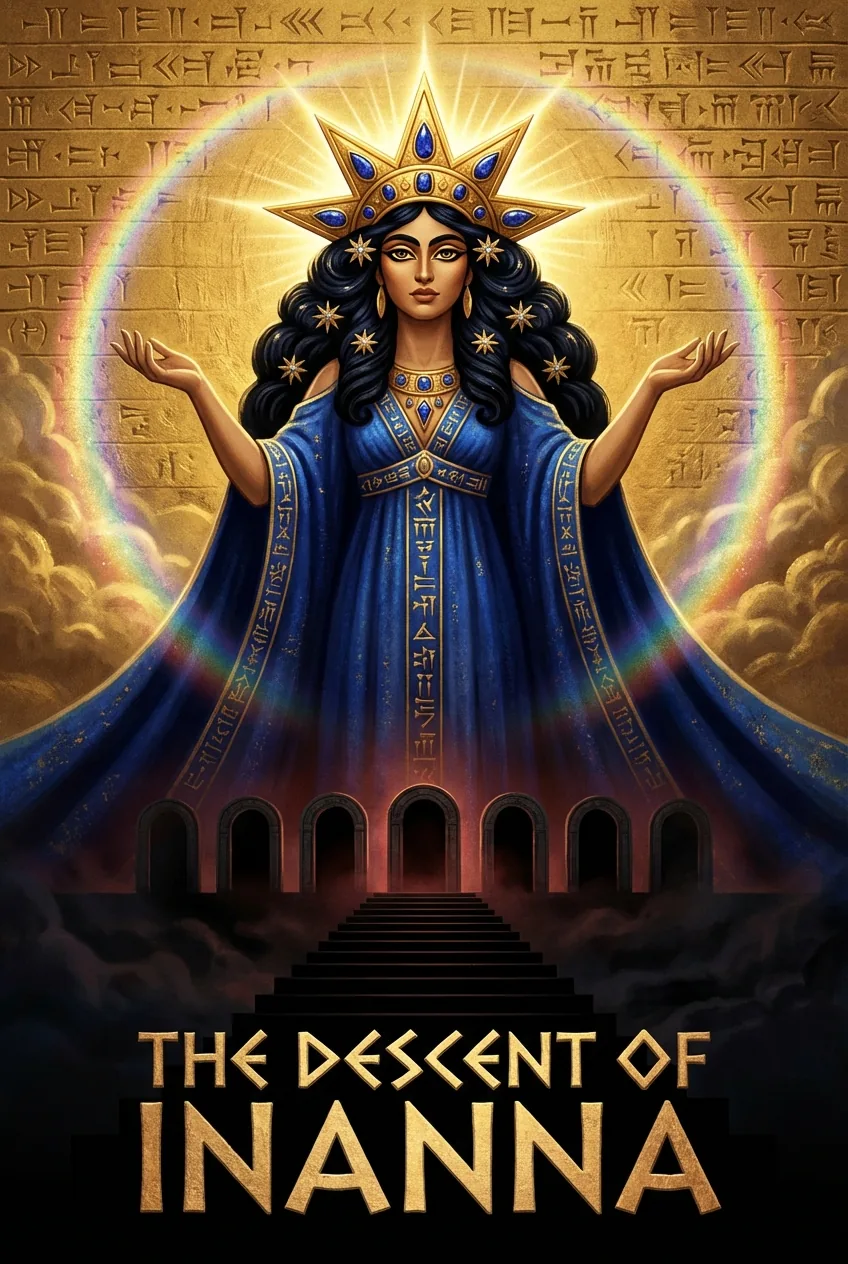
The comic retells the Sumerian myth usually called Inanna’s Descent to the Netherworld: a story about a goddess who leaves the upper world, passes through seven gates, is stripped of her powers, dies, and returns changed.
It is not a simple adventure story. It is an initiation pattern.
What happens in the myth
Inanna is the Sumerian goddess of love, war, power, and the planet Venus. She decides to descend into the realm of her sister Ereshkigal, queen of the dead. At every gate, the gatekeeper removes one piece of Inanna’s royal identity: crown, jewels, breastplate, measuring rod, and clothing. By the end she reaches the underworld naked and powerless.
Then the underworld does what the underworld does: it judges her. In the Sumerian version, the Anunna judges condemn her; Ereshkigal’s realm turns the queen of heaven into a corpse, hung on a hook.
Inanna does return, but not for free. Enki sends beings who respond to Ereshkigal’s suffering with empathy, not conquest. They receive Inanna’s body and revive her. But someone must take her place below. When Inanna sees that Dumuzi has not mourned her, she allows the underworld demons to take him. Later, his sister Geshtinanna shares the burden, creating a cycle of absence and return.
Enheduanna and the other Inanna story
There are two related traditions that are easy to collapse into one.
The Descent of Inanna is an anonymous Sumerian myth preserved in later manuscripts.
The Exaltation of Inanna is associated with Enheduanna, high priestess of Ur and often described as the earliest named author in history. In that hymn, Enheduanna speaks in the first person from political and spiritual crisis: she had been expelled from her priestly office during a rebellion associated with Lugal-Ane, and she writes herself back through devotion to Inanna.
So the comic is about the anonymous descent myth, but it sits next to the Enheduanna tradition: a woman in exile, a goddess of terrifying agency, and language as a way back from dispossession.
Why this is a women’s initiation story
Many male initiation myths are built around conquest: leave home, kill the monster, return with the prize.
Inanna’s pattern is different. She does not win by defeating the underworld. She descends, is stripped, dies, is mourned, and returns only through grief, empathy, and substitution. The underworld is not a boss level. It is a condition that must be accepted before it can transform.
That is why the story feels modern. It understands that some changes cannot be solved through willpower. Some transitions require a stage of grief: crying, naming the loss, accepting the body, accepting dependence, accepting that return has a cost.
This is not weakness in the myth. It is the mechanism of transformation.
Why it belongs in Humans and Parenting
For adults, Inanna is a map of initiation: the loss of status, beauty, certainty, control, and the fantasy that life can move only upward.
For children, it can be held more gently: sometimes a hero goes into darkness not to fight it, but to learn what sadness is, why people cry, and how return can happen after loss.
That is why this comic lives in both Parenting and Humans. It is a visual story for a child, and also a short essay about grief, feminine agency, and the ancient idea that becoming whole requires a descent.